Resources
WAFOOD Brief 17 – The 2026 Washington State Food Security Survey: Findings from WAFOOD Wave 6
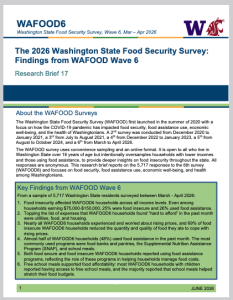
Published July 22, 2026, this brief presents findings from the 6th wave of the Washington State Food Security Survey, WAFOOD6 (March-April 2026). This brief reports on food security, food assistance use, economic well-being, and health among WAFOOD6 respondents. The WAFOOD6 survey was available in English, Korean, Russian, Simplified Chinese, Spanish, Somali, Tagalog, Ukrainian, and Vietnamese.
Key Findings
A total of 5,717 Washington State residents responded to the WAFOOD6 survey. Among the WAFOOD6 sample, which over-sampled households with lower incomes, food insecurity affected households across all income levels. Even among households earning $75,000-$150,000, 25% were food insecure and 26% used food assistance. Topping the list of expenses that WAFOOD6 households found “hard to afford” in the past month were utilities, food, and housing. Nearly all WAFOOD6 households experienced and worried about rising prices, and 69% of food insecure households reduced the quantity and quality of food they ate to cope with rising prices. Among food-insecure households, 86% reported high stress in the past month, and rates of anxiety and depression were higher than among food secure households. These findings highlight that food inflation is not only an economic concern but also a concern for nutrition, health, and wellbeing.
Almost half of WAFOOD6 households (48%) used food assistance in the past month. The most commonly used programs were food banks and pantries, the Supplemental Nutrition Assistance Program (SNAP), and school meals. Both food secure and food insecure WAFOOD6 households reported using food assistance programs, reflecting the important role these programs play in helping households manage food costs. Free school meals supported food affordability, with most households reporting that school meals helped stretch their food budgets.
Explore More: Find all briefs and publications related to this study on the project page.
Materials
Publication Date: July 22, 2026
Author(s): The WAFOOD survey is a joint effort between the University of Washington (UW) and Washington State University (WSU). The WAFOOD6 team comprises Jennifer J. Otten, Professor, Food Systems, Nutrition, and Health Program (FSNH) and DEOHS at the UW School of Public Health (SPH); Marie L. Spiker, Assistant Professor, FSNH, Epidemiology, and DEOHS at UWSPH; Jane Dai, Postdoctoral Associate, University at Buffalo; James H. Buszkiewicz, Research Assistant Professor, Epidemiology at University of Michigan SPH; Shawna Beese, Assistant Professor of Rural Health Promotion at WSU Health Sciences; Sarah M. Collier, Associate Professor, FSNH and DEOHS at UWSPH; and Alan Ismach, Research Coordinator, FSNH and DEOHS at UWSPH.
Resource Type(s): Briefs
Research Area(s): Food Access, Food Systems & Nutrition