Undergraduate Study
Degree Requirements
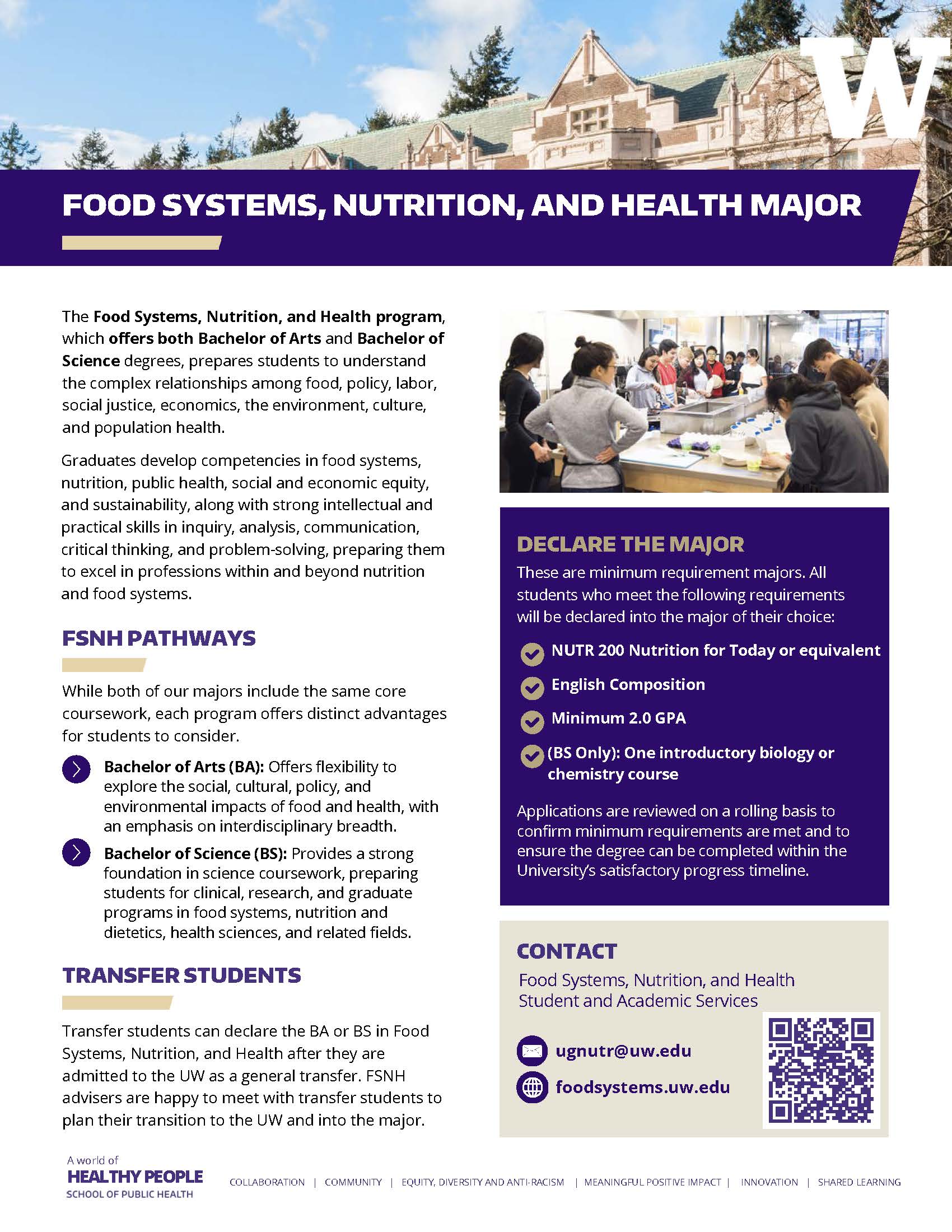
The BA and BS degrees in Food Systems, Nutrition, and Health share a common core curriculum and systems-based approach.
If you are unsure which major is best for you, you can read more about choosing between our majors or contact advising to discuss your options.
BA Degree Requirements
General Education
In addition to the degree-specific requirements below, you must complete all general education requirements for the School of Public Health.
Science Literacy
5 credits of biology. Choose from:
| BIOL 118 | Survey of Physiology (5, preferred) |
| BIOL 180 | Introductory Biology (5) |
| BIOL 161/162 | Advanced Placement credit |
5 credits of chemistry. Choose from:
| CHEM 120 | Principles of Chemistry I (5) |
| CHEM 142 | General Chemistry (5) |
| CHEM 143 | Accelerated General Chemistry (6) |
| CHEM 145 | Honors General Chemistry (5) |
Interdisciplinary Breadth
5 credits of economics. Choose from:
| ECON 200 | Introduction to Microeconomics (5) |
| ECON 201 | Introduction to Macroeconomics (5) |
| FISH 230 | Economics of Fisheries and Oceans (5) |
| ESRM/ENVIR/ECON 235 | Introduction to Environmental Economics (5) |
10 credits from courses that represent the breadth of areas that influence food systems. Current list is available on the Undergraduate Student Resources page.
Research Methods & Technologies
4-5 credits of statistics. Choose from:
| BIOST 310 | Biostatistics for the Health Sciences (4) |
| QMETH 201 | Introduction to Statistical Methods (4) |
| Q SCI 381 | Introduction to Probability and Statistics (5) |
| STAT 220 | Statistical Reasoning (5) |
| STAT 221 | Statistical Concepts and Methods for the Social Sciences (5) |
| STAT 290 | Advanced Placement (AP) Statistics (5) |
| STAT 311 | Elements of Statistical Methods (5) |
5 credits of qualitative methods. Choose from:
| NUTR 202 | Research Methods in Food Systems, Nutrition, and Health (5) (preferred) |
| ENVIR 301 | Research Methods in Environmental Studies (5) |
| GEOG 425 | Qualitative Methodology in Geography (5) |
| SOC 300 | Foundations of Social Inquiry (5) |
Food Systems Core
Students must complete the following core classes with a minimum 2.0 cumulative GPA.
| NUTR 200 | Nutrition for Today (5) |
| NUTR 302 | Food Systems: Harvest to Health (5) |
| NUTR 303 | Food Systems: Individual to Population Health (5) |
| NUTR 402 | Food Systems Modeling & Analysis (5) |
| NUTR 412 | US Food Systems Policy (5) Writing |
| NUTR 493 | Food Systems Capstone (6) |
Upper-Division Course Electives
20 credits of 300- and 400-level coursework. Current list is available on the Undergraduate Student Resources page.
BS Degree Requirements
General Education
In addition to the degree-specific requirements below, you must complete all general education requirements for the School of Public Health.
Supporting Sciences
5 credits of biology. Choose from:
| BIOL 118 | Survey of Physiology (5, preferred) |
| BIOL 180 | Introductory Biology (5) |
| BIOL 161/162 | Advanced Placement credit |
5 credits of chemistry. Choose from:
| CHEM 120 | Principles of Chemistry I (5) |
| CHEM 142 | General Chemistry (5) |
| CHEM 143 | Accelerated General Chemistry (6) |
| CHEM 145 | Honors General Chemistry (5) |
25 credits of additional science coursework. Choose from courses in chemistry, biology, physics, and other related subject areas. Current list is available on the Undergraduate Student Resources page.
Interdisciplinary Breadth
5 credits of economics. Choose from:
| ECON 200 | Introduction to Microeconomics (5) |
| ECON 201 | Introduction to Macroeconomics (5) |
| FISH 230 | Economics of Fisheries and Oceans (5) |
| ESRM/ENVIR/ECON 235 | Introduction to Environmental Economics (5) |
Research Methods & Technologies
4-5 credits of statistics. Choose from:
| BIOST 310 | Biostatistics for the Health Sciences (4) |
| QMETH 201 | Introduction to Statistical Methods (4) |
| Q SCI 381 | Introduction to Probability and Statistics (5) |
| STAT 220 | Statistical Reasoning (5) |
| STAT 221 | Statistical Concepts and Methods for the Social Sciences (5) |
| STAT 290 | Advanced Placement (AP) Statistics (5) |
| STAT 311 | Elements of Statistical Methods (5) |
5 credits of qualitative methods. Choose from:
| NUTR 202 | Research Methods in Food Systems, Nutrition, and Health (5) (preferred) |
| ENVIR 301 | Research Methods in Environmental Studies (5) |
| GEOG 425 | Qualitative Methodology in Geography (5) |
| SOC 300 | Foundations of Social Inquiry (5) |
Food Systems Core
Students must complete the following core classes with a minimum 2.0 cumulative GPA.
| NUTR 200 | Nutrition for Today (5) |
| NUTR 302 | Food Systems: Harvest to Health (5) |
| NUTR 303 | Food Systems: Individual to Population Health (5) |
| NUTR 402 | Food Systems Modeling & Analysis (5) |
| NUTR 412 | US Food Systems Policy (5) Writing |
| NUTR 493 | Food Systems Capstone (6) |
Upper-Division Course Electives
20 credits of 300- and 400-level coursework. Current list is available on the Undergraduate Student Resources page.
More Information
Find procedures, policies, forms, and more resources for completing the Food Systems, Nutrition, and Health major in the Undergraduate Student Resources section.